

Chemical foaming agents provide lightweighting, insulation, and cushioning properties in plastics, rubber, coatings, and sealants. However, challenges such as regulatory concerns, residual byproducts, odor, variability in cell size, and formulation complexity due to additives may arise depending on the application and region. As a result, exploring alternatives can be valuable for both compliance and performance.
ADVANCELL™, expandable microspheres from SEKISUI Specialty Chemicals, offer a physical foaming approach in which the particles expand upon heating. This solution addresses some of the noted challenges with chemical foaming agents. Unlike chemical foaming agents that generate gas through reactions, ADVANCELL™ enables controlled closed-cell structures and more uniform foaming. It can be considered not only as a full replacement but also for combined use, depending on base materials, processing conditions, and performance requirements.
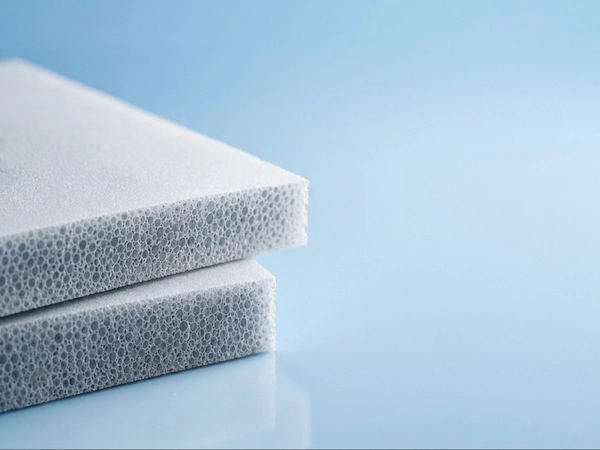
Chemical foaming agents are widely used for their high foaming efficiency in mass production. However, challenges such as residual products, odor, variability in cell size, and the need for temperature-adjusting additives can occur, depending on the application.
As lower density is pursued, it can become increasingly difficult to balance mechanical strength, appearance, dimensional stability, and processability. Additionally, materials such as ADCA may require attention to regulatory developments. In light of these issues, evaluating alternative or complementary solutions in advance can help mitigate these challenges. Organizing key parameters—including base material, processing temperature, target density, and production conditions—supports more effective formulation design.
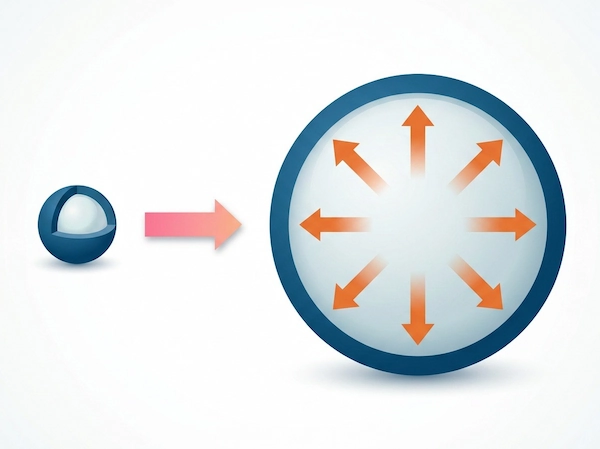
ADVANCELL™ is a physical foaming material that expands upon heating rather than generating gas through chemical reactions. Each particle consists of a thermoplastic polymer shell encapsulating a low-boiling hydrocarbon. When heated, the shell softens, and the internal component expands, forming fine microballoons.
This mechanism allows easier formation of closed-cell structures and a more uniform foam morphology with fewer concerns about byproducts. SEKISUI Specialty Chemicals’ design enables the selection of particle size and expansion temperature by application, contributing to improved appearance, reduced irregularities, and better control of density and properties. ADVANCELL™ can be used alone or in combination with chemical agents as needed.
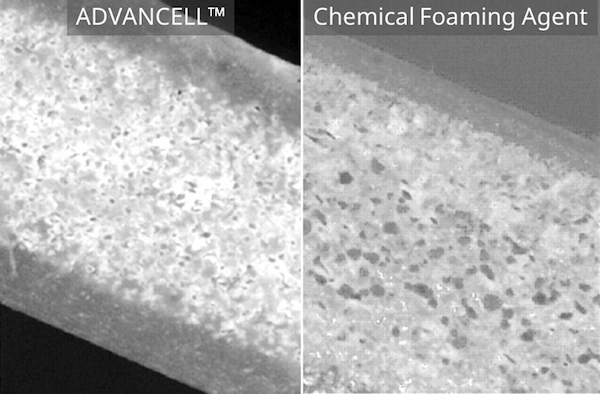
Both ADVANCELL™ and chemical foaming agents are used for lightweighting, insulation, and cushioning, but differ in mechanisms and cell results. Chemical agents generate gas via decomposition, often leaving byproducts, odor, and variable cell structures.
ADVANCELL™ expands via particle volume growth, with the polymer shell remaining to support closed, uniform foam. The optimal solution should be evaluated for density, expansion, quality, residuals, temperature, and cost. Combination and partial substitution are also options.
| Comparison Item | ADVANCELL™ (Expandable Microspheres) |
Chemical Foaming Agents |
|---|---|---|
| Foaming Mechanism | Particle expansion upon heating | Gas generation through chemical reaction |
| Cell Structure | Tends to form closed-cell structures | May form open or interconnected cells |
| Foaming Efficiency | Moderate | High |
| Processing Temperature Range | Approx. 100–250°C | Approx. 140–210°C |
| Temperature Response | Less dependent on additives | May require additives for temperature control |
| Residual Byproducts | Minimal risk, as no chemical reaction occurs | May generate decomposition residues and byproducts |
| Post-Foaming Structure | Polymer shell remains, supporting uniform foam structure | Foam structure depends on formulation and process conditions |
| Key Advantages | Closed-cell formation, uniform foam, reduced residue risk, stable processing | High expansion ratio, proven use in existing formulations |
| Recommended Applications | ADCA alternative, lightweighting, cell control, balance of properties | High expansion needs, cost-focused applications, maintaining existing processes |
Actual applicability and foaming characteristics vary depending on the base material, additive content, mixing conditions, molding temperature, heating time, and product shape. Evaluation based on specific conditions is required.

When considering replacing chemical foaming agents with expandable microspheres, evaluate not only foaming occurrence but also performance under real processing conditions. ADVANCELL™ offers controlled expansion onset temperature, improved dispersion, consistent target density, and maintains mechanical strength, surface appearance, and dimensional stability after foaming.
ADVANCELL™ provides various grades with different particle sizes and expansion characteristics for use in plastics, rubber, coatings, and sealants. Organizing parameters such as base material, processing method, temperature, heating time, current agents, and required properties helps determine whether to fully replace, combine, or optimize the dosage. Consultation on grade selection and evaluation is available.
Q. Can I completely replace chemical foaming agents?
A. This depends on the application, base material, processing conditions, and required expansion ratio. In some cases, ADVANCELL™ can fully replace chemical foaming agents, while in others, a combination or partial substitution may be more effective. Evaluating both options is recommended.
Q. Can ADVANCELL™ replace ADCA?
A. ADVANCELL™ can be considered as an alternative when concerns exist regarding ADCA regulations, residues, or odor. However, as the foaming mechanisms differ, evaluation under actual processing conditions is necessary.
Q. What are the main benefits of ADVANCELL™?
A. Key benefits include easier formation of closed cells, more uniform foam structures, reduced risk of reaction-related byproducts, and flexibility in grade selection based on expansion characteristics.
Q. What materials can I apply it to?
A. ADVANCELL™ can be evaluated for a wide range of materials, including PVC, EVA, PE, PP, EPDM, and epoxy, as well as coatings, sealants, and adhesives.
Q. Can I use it together with chemical foaming agents?
A. Yes, combination use may be effective, especially when improving foam structure or maintaining existing formulations while enhancing performance.