
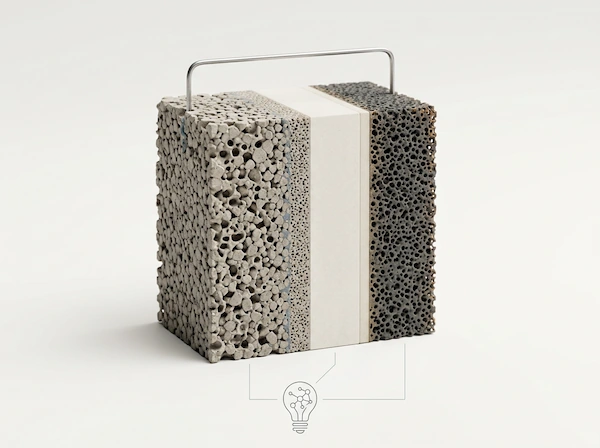
In SOFC (solid oxide fuel cell) and SOEC (solid oxide electrolysis cell) manufacturing, slurries containing ceramic and electrode materials are tape-cast or screen-printed, then dried, laminated, debound, and fired. Binder requirements change with cell structure, support layer, film thickness, and firing atmosphere.
Both large and thin green sheets need strength and flexibility to resist cracking during drying and handling. Printed laminates require printability, interlayer adhesion, and careful control of gas release during debinding. For processes fired in inert atmospheres, such as metal-supported cells, minimizing residual carbon is essential.
SEKISUI Specialty Chemicals supports process-specific material selection and evaluation with S-LEC™ B/SV Series (PVB) and S-LEC™ AS Series (specialty acrylic).
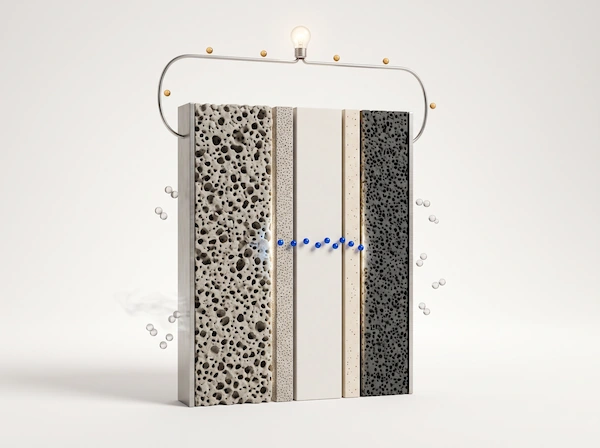
Binder selection should consider not only the resin’s strength and decomposition temperature but also its interactions with the powder, solvent, plasticizer, solids content, forming method, drying and lamination conditions, and firing atmosphere. In tape casting for electrolyte-supported cells, dried green strength and flexibility are key to preventing cracks and handling damage.
For screen-printed laminates, such as in anode-supported cells, evaluate leveling, interlayer adhesion, effects on the sheet, and debinding behavior together. For metal-supported cells or processes that require lower-temperature debinding, assess decomposition behavior and residues in inert atmospheres. Prioritize evaluation items based on target thickness and process conditions to achieve more efficient material selection.
SEKISUI Specialty Chemicals proposes candidate PVB and specialty acrylic binders based on key properties for tape casting, printed lamination, and debinding/firing.
S-LEC™ B Series offers grades with different polymerization levels and compositions, supporting designs that balance green sheet strength, flexibility, and handling. S-LEC™ SV Series is a PVB designed to combine interlayer adhesion with low residual carbon in screen-printed laminates. S-LEC™ AS Series is a specialty acrylic designed to decompose at lower temperatures while maintaining the green strength needed for handling. Beyond introducing materials, we review your powder, solvent, solids content, and drying/firing conditions, then help prioritize evaluation items, select candidates, and refine choices based on results.
Select candidate materials by combining the target layer, forming method, target thickness, firing atmosphere, adhesion, and residue tolerance—not by cell structure alone. For large, thin green sheets, start with S-LEC™ B Series and check dried strength, flexibility, and handling. For screen-printed laminates, use S-LEC™ SV Series and evaluate print shape, interlayer adhesion, sheet effects, and post-debinding condition. Where inert atmospheres or lower-temperature decomposition are priorities, use S-LEC™ AS Series and assess it by TGA and post-firing residue.
The table below helps identify options that align with your process; share your material and process conditions when you contact us to focus the evaluation from the start.
| Cell Structure / Process | Key Challenges | Candidate Series | Key Evaluation Items |
|---|---|---|---|
| Electrolyte-supported, etc. / Tape casting | Cracking, handling | S-LEC™ B | Strength, elongation at break, appearance after drying |
| Anode-supported, etc. / Printed lamination | Interlayer adhesion, residue | S-LEC™ SV | Print shape, tack, TGA, appearance after firing |
| Metal-supported / Inert atmosphere | Residual carbon, low-temperature debinding | S-LEC™ AS | TGA in air and N2, strength, residue after firing |
| SOEC, low-temperature operating cells, etc. | Leveling and debinding | S-LEC™ AS | Case-by-case review of application data and process conditions |
Assess a material’s value with data that includes evaluation methods, comparison references, and test conditions, not just feature descriptions. For S-LEC™ B Series, tensile tests on representative grades show different balances of breaking strength and elongation at break, helping you select candidates according to the required sheet strength and flexibility. For S-LEC™ SV Series, evaluation examples include tack tests comparing interlayer adhesion with ethyl cellulose and TGA measurements of the residue. For S-LEC™ AS Series, tensile tests and TGA in air and nitrogen confirm green strength and decomposition behavior.
Use representative data for initial screening, then re-evaluate using your actual slurry and process to reduce the risks associated with material changes.
When designing porous electrode structures, consider not only the type and amount of pore former, but also the granulation state of the ceramic powder and the forming conditions. Granulate fine powders with S-LEC™ KW Series, a water-based PVB, and then form the granules to explore structures that use inter-particle voids. Adjust resin content, granule size, forming pressure, and debinding/firing conditions, including combined use with pore formers. This lets you evaluate handling, decomposition gas volume, and post-firing porosity together.
Because applicability depends on the powder and target structure, review your current powder, pore-forming method, forming conditions, and target pore properties to propose an evaluation plan.
Q. Which series should I start with?
A. Start with S-LEC™ B Series for tape casting, S-LEC™ SV Series for screen-printed lamination, and S-LEC™ AS Series when inert-atmosphere processing or lower-temperature decomposition is a priority. Final selection depends on your powder, solvent, solids content, film thickness, and drying and firing conditions.
Q. How thin can the film be?
A. Achievable thickness depends on powder particle size, slurry formulation, forming method, drying conditions, carrier film, and measurement method. Share your target thickness and process conditions, and we will propose a suitable evaluation approach.
Q. Can it be used in a nitrogen atmosphere?
A. S-LEC™ AS Series includes materials evaluated for decomposition behavior in inert atmospheres. Suitability depends on heating rate, holding time, gas flow rate, and coexisting components, so confirm it against your firing profile.
Q. Can it replace ethyl cellulose?
A. For S-LEC™ SV Series, we have evaluation examples comparing lamination adhesion and thermogravimetric behavior with ethyl cellulose under our test conditions. Because solubility, viscosity, print shape, and drying behavior may also change, evaluate the formulation and process together rather than treating it as a simple drop-in replacement.
Q. What information do you need when I request a sample?
A. Share your cell structure, target layer, powder and solvent, solids content, forming or printing method, target thickness, drying conditions, firing atmosphere, and temperature profile, and any current issues. The more information you provide, the more precisely we can identify candidate materials and evaluation items.